
How I Learned Chinese Characters as a Complete Beginner
From a Self-Taught Learner
When I first started learning Chinese, I really thought characters were impossible. There were thousands of symbols and strange strokes, and no alphabet — just looking at a page of hanzi made my brain feel a bit overwhelmed. I tried writing characters over and over again, but nothing stuck. I was feeling a bit frustrated, a little overwhelmed, and on the verge of giving up.
But after months of experimenting, I finally discovered a simple system that made Chinese characters manageable — even enjoyable!
In this guide, I’ll share exactly how I learned Chinese characters as a complete beginner using radicals, mnemonics, and spaced repetition.
If you’re a self-learner like me, I really hope this helps you to build confidence and avoid the mistakes I made.
Why Characters Felt So Hard at First
Don’t you think the characters looked like random drawings?
I didn’t know how they were structured or why certain lines were grouped together. I made a bit of a mistake at first, as I treated every character as if it was a brand-new symbol that I had to memorise from scratch.
But don’t worry, Chinese characters aren’t random. They’re lovingly crafted from smaller, meaningful components. Once I learned how characters actually work, everything changed.
Learning Radicals
Radicals are the “building blocks” of Chinese characters!
They’re like LEGO pieces that come together to form full characters. Many radicals represent ideas or categories, so understanding them makes characters so much more meaningful.
For example:
-
木 (wood) appears in characters related to trees or plants:
森 (forest), 树 (tree), 桌 (table) -
氵 (three-water radical) appears in characters related to water or liquids:
河 (river), 洗 (wash), 海 (sea)

Learning radicals was a real game-changer for me, it allowed me to break characters down into smaller, more manageable pieces. Instead of having to memorise a whole symbol without knowing what it means, I could just say:
“Oh, this character has the water radical. So it’s probably something to do with water.”
That little insight made memorising so much easier, and I’m so grateful for it.
How I Learned Radicals as a Beginner
-
I started with the 50 most common radicals.
-
For each radical, I learned:
-
the meaning
-
the story/idea behind it
-
a few example characters
-
-
I built a small “radical notebook” where I drew them like doodles.
-
I reviewed 5–10 radicals a day for the first two weeks.
Within a month, I understood the structure of hundreds of characters — even ones I hadn’t officially learned yet.
Using Mnemonics to Remember Characters Easily
The second key to learning characters was mnemonics — these are memory tricks that help you create a story for a character.
Before mnemonics, I would keep repeating characters over and over again, but then I would forget them just 10 minutes later.
I found that, after using mnemonics, I was able to remember characters for weeks with almost no effort at all, which was really great!
How Mnemonics Work
Each character becomes a mini-story.
You take the radicals → imagine a picture → connect it to the meaning.
Here are some examples from my own study notes:
Example 1: 安 (peace, safe)
Radicals:
-
宀 (roof/home)
-
女 (woman)
My mnemonic story:
“A woman under a roof feels safe and peaceful.”
Simple, vivid, and hard to forget.
Example 2: 忘 (to forget)
Radicals:
-
亡 (to lose)
-
心 (heart)
Story:
“When you lose your heart, you forget everything.”
This story sounds dramatic, but that’s why it sticks.
Why Mnemonics Work
Your brain is so much better at remembering stories than lines and strokes, isn’t it?
Mnemonics are so clever! They make characters feel personal, emotional, and visual, which is just fantastic at triggering memory.
My Mnemonic Routine (Beginner-Friendly)
-
Step 1: Look at the radicals
-
Step 2: Create a quick story
-
Step 3: Draw a small picture in the margin (optional but fun)
-
Step 4: Review the story the next day
After a few weeks, I didn’t even need stories anymore because the characters became familiar.
Spaced Repetition — The Technique That Locked Everything Into Memory
The third piece of my system was spaced repetition (SRS), a scientifically proven way to remember information long-term.
Instead of reviewing characters randomly, SRS repeats them at the exact moment you’re about to forget — which strengthens your memory.
I used SRS with Notion:
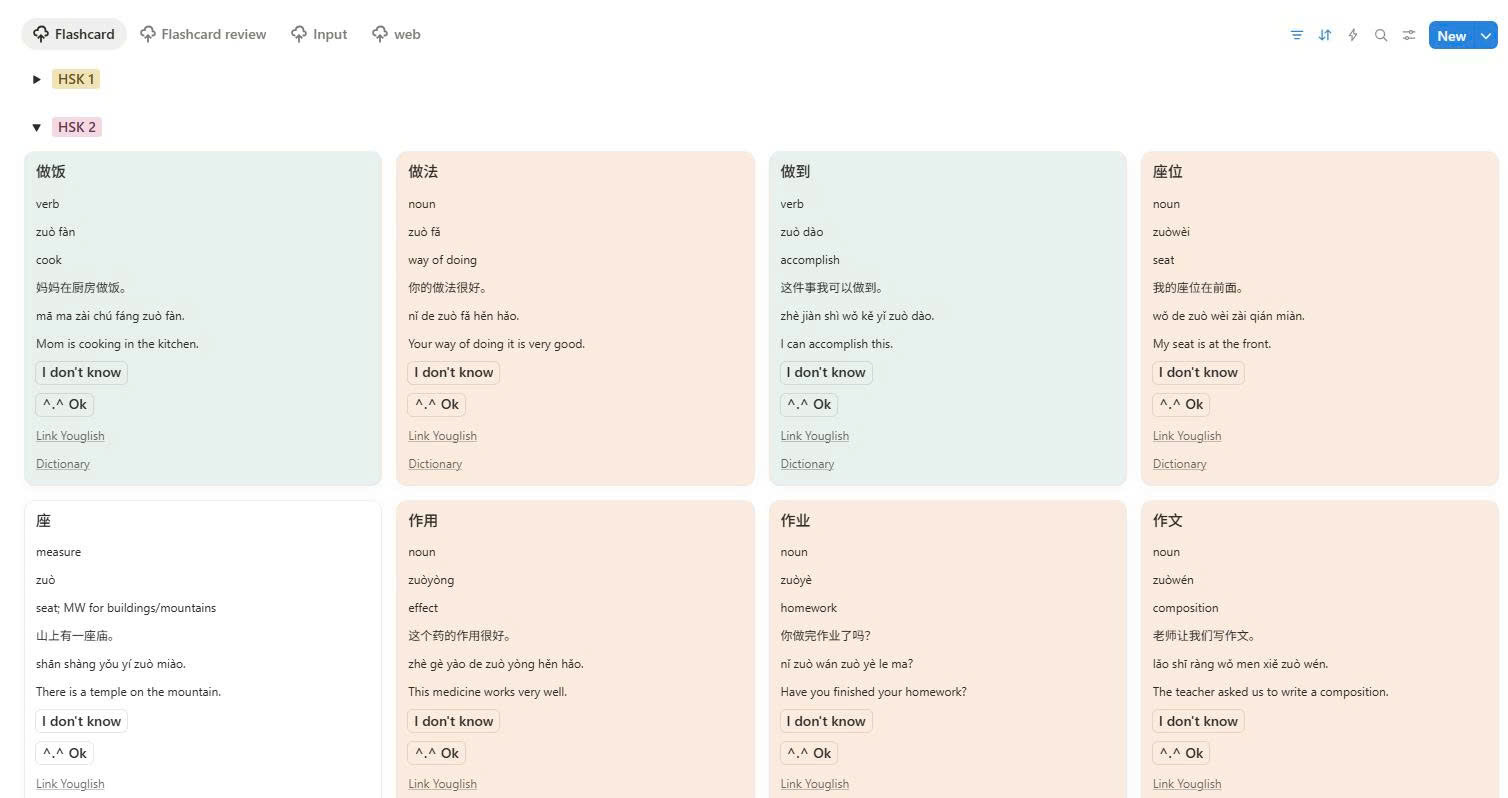
How I Used SRS as a Beginner
Every day:
-
10 minutes reviewing “due” cards.
I set up that If I know the words, I’ll review them next week. Is not, I’ll see them tomorrow. -
5 minutes adding new characters
That’s it.
After three months of consistent SRS reviews, I memorized ~150 HSK 1 characters and know how to use them in sentences.
SRS managed to transform characters from a mountain into a staircase!
My Simple Weekly Character Learning System
Here’s the exact routine I followed as a self-learner.
Daily (10–15 minutes)
-
Review Nontion SRS cards
-
Write 5–10 characters slowly + full sentence use them
-
Check pronunciation with Hanzii or Pleco audio
Weekly (30–40 minutes)
-
Review radicals learned
-
Choose 20 new characters for the week
-
Create mnemonic stories
-
Practice reading simple sentences
Monthly
-
Review all characters learned
-
Test myself using:
-
graded readers
-
flashcards
-
short texts online
-
The key was consistency, not speed.
What Didn’t Work For Me
✘ Writing characters 100 times, it’s so boring
✘ Learning characters without understanding radicals, I absolutely foget them after learning.
✘ Memorizing lists without context. If learn like this, I understand the meaning but can’t use the words
✘ Trying to learn too many characters at once. So tired!
✘ Skipping reviews and relying on “cramming”
Final Thoughts
I know how it is when you’re just starting out and it feels like learning Chinese characters is impossible. But once I learned to break characters into radicals, create simple stories, and use spaced repetition, everything became manageable.
You don’t need talent.
You don’t need a teacher.
All you need is a good method and consistency, and you’ll be golden!
If I can do it as a self-taught learner, I’m sure you can too!
If you want, I can also write:
✅ How I Learned Chinese Tones as a Beginner
✅ My 30-Day Character Learning Challenge
✅ 50 Radicals Every Beginner Should Learn First



0 Comments